

Supply chain disruptions are no longer exceptional events. Supplier delays, transport constraints, geopolitical developments, compliance issues and shifting customer demand can all affect the performance of an interconnected network.
While many enterprises recognise that risk exists within their supply chains, risk management is still too often reactive. By the time a disruption becomes visible, service levels, costs and customer commitments may already be affected.
A resilient supply chain begins with understanding risk during network planning and re-planning, then using operational visibility to identify emerging issues early and respond with confidence.
Why Supply Chain Risk Must Be Considered During Network Design
Supply chain network design determines how products, materials and information move across suppliers, manufacturing locations, warehouses, distribution centres and customers.
Decisions made during network design can directly affect exposure to risk, including:
- Dependence on single suppliers or locations
- Limited transport or distribution alternatives
- Capacity constraints at critical nodes
- Long replenishment lead times
- Geographic, regulatory or geopolitical exposure
- Insufficient inventory positioning during disruption
For this reason, organisations should identify and categorise supply chain risks during the planning process, assess their likely causes, and evaluate both the likelihood and potential impact of each risk.
This allows decision-makers to prioritise the risks that matter most and design networks that are better prepared for uncertainty.
Balancing Resilience, Cost and Service
Good network design can significantly improve supply chain resilience. However, every mitigation strategy involves trade-offs.
Adding alternative suppliers may improve continuity but increase sourcing complexity. Holding additional inventory may protect service levels but raise working capital requirements. Introducing additional distribution points may reduce response times while increasing operating cost.
The objective is not simply to remove risk at any cost. It is to develop tailored mitigation strategies that achieve the right balance between:
- Risk reduction
- Cost efficiency
- Service performance
- Operational flexibility
- Long-term business objectives
By testing different network scenarios before disruption occurs, businesses can make more informed investment decisions and create a supply chain that is both efficient and resilient.
Optimise the Network with Project Argus Network Design Software
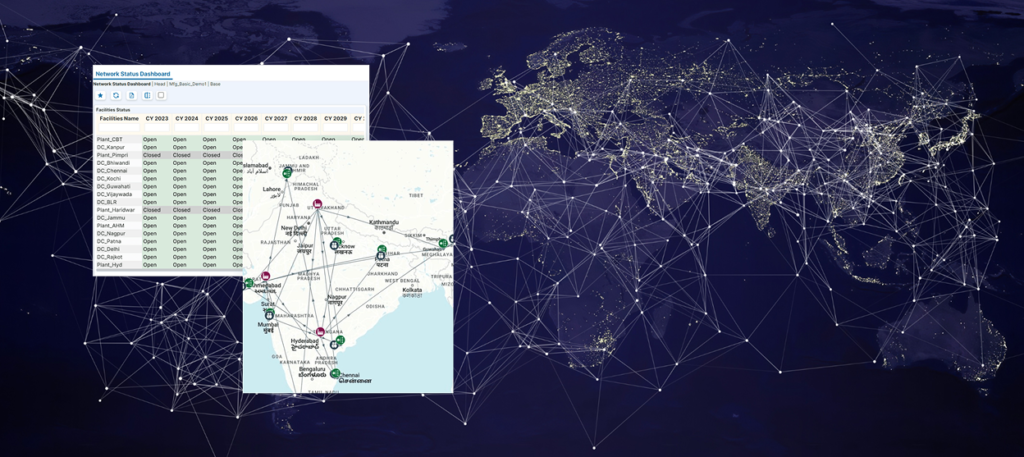
Project Argus Network Design Software helps organisations evaluate supply chain structures, model alternatives and understand how strategic decisions influence cost, service and risk.
The solution supports enterprises by:
- Applying mathematical optimisation while considering real-world business constraints across the network
- Enabling rapid what-if scenario analysis to compare sourcing, inventory, facility and distribution alternatives
- Supporting supply chain risk analysis to guide more informed investment and resilience decisions
- Helping businesses identify network configurations that balance efficiency with continuity
Rather than relying solely on historic operating assumptions, businesses can model potential disruptions, evaluate alternative strategies and redesign their networks around changing conditions.
Strengthen Execution with VisibilityPro (VPro)
Network design establishes the foundation for resilience. VisibilityPro, or VPro, strengthens that foundation during day-to-day execution.
VisibilityPro is Project Argus’ intelligent control tower solution, designed to help organisations move from reactive supply chain management to more coordinated and proactive execution. It unifies operational data and external signals to provide visibility across orders, inventory, shipments and risk events.
With VisibilityPro, organisations can:
- Monitor supply chain operations through real-time end-to-end visibility
- Identify likely delays, demand shifts and capacity constraints earlier through predictive intelligence
- Receive prescriptive decision support that considers cost, service and operational trade-offs
- Detect supplier, transport, geopolitical and compliance risks before they escalate
- Coordinate responses across internal teams, suppliers, logistics partners and customers
- Automate exception management and routine workflows for faster, more consistent action
Together, Network Design Software and VisibilityPro connect strategic resilience planning with operational execution: the network can be designed with risk in mind, then monitored and managed as conditions evolve.
From Reactive Response to Proactive Resilience
A resilient supply chain requires more than reacting quickly after a disruption occurs. It requires organisations to anticipate vulnerabilities, assess potential consequences and prepare appropriate responses before risks become costly operational events.
Project Argus helps enterprises build this capability through a combination of optimised network design and intelligent operational visibility.
With Network Design Software supporting scenario modelling and investment decisions, and VisibilityPro enabling earlier detection and coordinated response, businesses can strengthen continuity, improve decision-making and remain competitive in an increasingly complex supply chain environment.
Build a More Resilient Supply Chain
Supply chain risk cannot always be avoided, but its impact can be better understood, managed and mitigated.
By combining proactive network design with real-time visibility and predictive decision support, organisations can prepare for disruption while continuing to optimise cost, service and performance.
Discover how Project Argus Network Design Software and VisibilityPro can help your organisation design, monitor and manage a more resilient supply chain.
Contact us today at +65 9710 5800 or info@projectargus.co